As a lot of ideas start, I saw something on Pinterest. The original idea related to Long Division, but the idea of using bookmarks to help students keep track of steps seemed applicable to more than just math equations. Since my students have been struggling with word order lately, I saw a great application for it with my eighth graders.
I created these bookmarks to help students keep track of a basic German sentence and to help break down what "miscellaneous" sentence elements are (something that's come up more and more as we start talking about time expressions, direct objects, adjectives, and inverted word order).
I made these bookmarks using card stock, pipe cleaners, and beads. All in all it probably cost $15 for all the supplies, but I could easily make hundreds more than the class set I made and gave out. As students write their sentence, they slide the bead down the pipe cleaner to keep track of where they are in the sentence. The bead will show them what they need to add next, whether it’s a subject, direct object, specific verb type, etc. and eliminate the question of "Where does this go? What comes next?"
Although I made a class set and gave them out, I think in the future I would create perhaps 10-15 for a class and only hand them out for in class usage. This way students have it as a reference but I don't have to keep re-making them. I also plan on color coding them so that each type of word order (basic sentence vs question vs inverted word order, etc) are on a different color card stock.
I created a bunch of bookmarks featuring different types of word order that I can pull out as we get to different topics. If you're interested, they're available on my TPT store!
I also would recommend students use the back of the bookmarks for other details. For my students doing the basic present tense, the back is a great spot for writing a verb conjugation chart. For students using the modal verbs bookmarks, writing a list of the modal verbs and perhaps conjugating those as well would be a good extra reference. Other ideas: listing the subordinating conjunctions and their meanings, giving examples of TMP elements, and giving examples of weak and strong verbs.
- Frau Leonard
Resources, activities and ideas to help German teachers inside and outside the classroom.
Tuesday, February 12, 2019
Word Order Bookmarks
Monday, October 30, 2017
The Bluffing Game: Full Class Review
As any of my readers might know, I like to incorporate games into instruction as often as possible. It helps keep students engaged in the lesson while breaking up the monotony of students' school days. One game I like to do with students is generally called The Bluffing Game.
Overview:The Bluffing Game is a full class activity that has students both work with teams and on their own to practice vocab, culture, or grammar topics. This is a good practice activity that you can do mid-way through the unit or at the end as a review.
What You'll Need:Questions/activities for the class. You'll want at least 18 questions along with a bonus question (I tend to do translations as the last question). I tend to find it easiest to have all the questions in a Power Point so that it's easier for the students to see the questions.
Types of questions might include:
- Defining words (based on Target Language descriptions)
- Sentence completion
- Changing words: making them singular/plural, changing the case, changing the subject, changing the tense, changing the article, etc
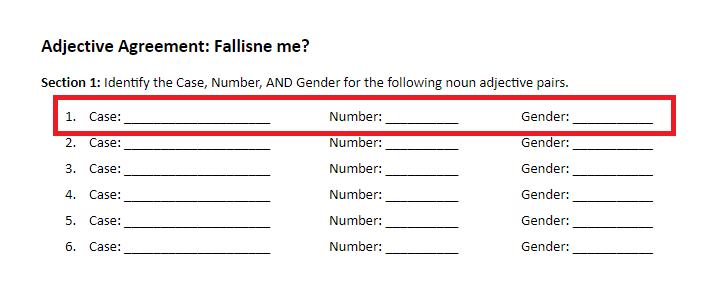
- Identifying features of words (for example Case, Number and Gender for nouns)
I try to do multiple question types during each game to hit on a couple different topics.
For lower level classes, I like to give students a worksheet to complete the questions/activities. This way students are responsible for paying attention even if they're not actively participating to the game.
How to Play:
As I go through how to play this game, I will be using this Latin Adjective Review. It's designed for a Level 1 Latin class that is learning Adjective/Noun Agreement for 1st and 2nd Declension Nouns. I use this worksheet to go along with the game.
1. Divide the class into 2-3 teams (depending on the size). Each team will be gaining or losing points together, but students are responsible for their own answers.
2. Each question will be presented one at a time. The entire class will get to see the question, but only one team at a time will get a chance to answer.
Present the first time with their first question.
Even though only the first team will get a chance to answer this questions for points, all students should write down their answer on their worksheets. Students are not allowed to use their notes or talk to each other - this part is an individual practice of the skills in this unit.
After giving students time to respond to the question, it's time to reveal the answer...
3. The next part is ONLY directed at the first team. Tell students that if they think they know the answer, they should stand up. Students aren't allowed to discuss with their group members a plan, they either stand up or they stay seated. If they stand up, though, they might be required to give their answer to the class. Write down the number of students who are standing on the board.
Tell the students who are standing that they should NOT call out an answer unless YOU ask them to.
4. This part is ONLY directed at the NEXT team. Ask these students to pick one of the students who is standing to answer. They can discuss with their group who they want to answer. When they've made their final decision, they tell you and then YOU ask that that student to reveal their answer.
If students who are standing call out an answer before YOU ask them to, that's an automatic wrong answer. Make sure you emphasize this to students beforehand.
5. The student reveals their answer, then you put the correct answer on the board for everyone to see.
If their answer is correct, their team gains points for each person who stood up. If their answer is incorrect, their team loses those points. So if seven students stood up, the team would gain seven points for a correct answer and lose seven points for an incorrect answer.
6. Move on to the next team. The process repeats with a new question for the next team. Cycle through all the teams until you're out of questions (though make sure each team gets the same number of questions). Keep track of the points on the board.
7. Strategy: It's called the Bluffing Game for a reason - students don't actually need to know the correct answer to help their team gain points. If they stand up confidently, they're less likely to get picked. If they hesitate and make a show of being uncertain, it might increase their chances of being called to answer. Let students know this as you go through more rounds. It adds an extra bit of fun for students :)
8. At the end of the game, I like to include a bonus round. This is usually a short translation. Students wager the points they have - if they get the sentence completely correct, they'll get that many points, but if there's even one error, they'll lose that many points. Students need to wager before they get to see the sentence.
Note: For teams that are in the negatives, tell them you'll boost them to +5 points if they get it right (or some other positive number, just so they're still in the game).
Once wagers are in, show the class the sentence. At this point, students are allowed to work with their group and use their notes. They only need to submit one answer per team.
9. Once all the teams have submitted their sentence, reveal how each team did and determine the winner.
Hopefully this is a game your students will enjoy playing - I know mine tend to get pretty competitive with it! Let me know if you have any questions or if you try it out and have recommendations for tweaks!
- Frau Leonard
What You'll Need:Questions/activities for the class. You'll want at least 18 questions along with a bonus question (I tend to do translations as the last question). I tend to find it easiest to have all the questions in a Power Point so that it's easier for the students to see the questions.
Types of questions might include:
- Defining words (based on Target Language descriptions)
- Sentence completion
- Changing words: making them singular/plural, changing the case, changing the subject, changing the tense, changing the article, etc
- Identifying features of words (for example Case, Number and Gender for nouns)
I try to do multiple question types during each game to hit on a couple different topics.
For lower level classes, I like to give students a worksheet to complete the questions/activities. This way students are responsible for paying attention even if they're not actively participating to the game.
How to Play:
As I go through how to play this game, I will be using this Latin Adjective Review. It's designed for a Level 1 Latin class that is learning Adjective/Noun Agreement for 1st and 2nd Declension Nouns. I use this worksheet to go along with the game.
1. Divide the class into 2-3 teams (depending on the size). Each team will be gaining or losing points together, but students are responsible for their own answers.
2. Each question will be presented one at a time. The entire class will get to see the question, but only one team at a time will get a chance to answer.
Present the first time with their first question.
Even though only the first team will get a chance to answer this questions for points, all students should write down their answer on their worksheets. Students are not allowed to use their notes or talk to each other - this part is an individual practice of the skills in this unit.
After giving students time to respond to the question, it's time to reveal the answer...
3. The next part is ONLY directed at the first team. Tell students that if they think they know the answer, they should stand up. Students aren't allowed to discuss with their group members a plan, they either stand up or they stay seated. If they stand up, though, they might be required to give their answer to the class. Write down the number of students who are standing on the board.
Tell the students who are standing that they should NOT call out an answer unless YOU ask them to.
4. This part is ONLY directed at the NEXT team. Ask these students to pick one of the students who is standing to answer. They can discuss with their group who they want to answer. When they've made their final decision, they tell you and then YOU ask that that student to reveal their answer.
If students who are standing call out an answer before YOU ask them to, that's an automatic wrong answer. Make sure you emphasize this to students beforehand.
5. The student reveals their answer, then you put the correct answer on the board for everyone to see.
If their answer is correct, their team gains points for each person who stood up. If their answer is incorrect, their team loses those points. So if seven students stood up, the team would gain seven points for a correct answer and lose seven points for an incorrect answer.
6. Move on to the next team. The process repeats with a new question for the next team. Cycle through all the teams until you're out of questions (though make sure each team gets the same number of questions). Keep track of the points on the board.
7. Strategy: It's called the Bluffing Game for a reason - students don't actually need to know the correct answer to help their team gain points. If they stand up confidently, they're less likely to get picked. If they hesitate and make a show of being uncertain, it might increase their chances of being called to answer. Let students know this as you go through more rounds. It adds an extra bit of fun for students :)
8. At the end of the game, I like to include a bonus round. This is usually a short translation. Students wager the points they have - if they get the sentence completely correct, they'll get that many points, but if there's even one error, they'll lose that many points. Students need to wager before they get to see the sentence.
Note: For teams that are in the negatives, tell them you'll boost them to +5 points if they get it right (or some other positive number, just so they're still in the game).
Once wagers are in, show the class the sentence. At this point, students are allowed to work with their group and use their notes. They only need to submit one answer per team.
9. Once all the teams have submitted their sentence, reveal how each team did and determine the winner.
Hopefully this is a game your students will enjoy playing - I know mine tend to get pretty competitive with it! Let me know if you have any questions or if you try it out and have recommendations for tweaks!
- Frau Leonard
Labels:
activity,
bluffing game,
game,
games,
grammar practice,
review,
vocab practice
Thursday, November 5, 2015
ThingLink and Padlet: Aeneas
These are two online resources that I've been meaning to try for a long time but only just implemented today with my Latin 1 class. This specific lesson, although part of a lesson on the Trojan War and Aeneas, could be used with any character study or story summary.
I gave students several images related to the stories we'd talked about. With their groups, they needed to create a ThingLink for two of them. With ThingLink, they had to put in thought bubbles for what the characters were thinking about during that scene. I used this one I had done as an example:
ThingLink is free, but students did need to sign up for an account.
The next step was to post their images somewhere that was accessible to both me and other students. For this, I created a Padlet page. Padlet only requires me to have the account, so it was easy for students to post. I helped walk students through how to post images (it's actually really simple, I promise!). Once posted, anyone can view them. Here's our class Padlet for this assignment:
I liked the ThingLink activity as an alternate way of assessment for this topic. It's relatively easy once students know what they're doing (and now we can do it with later myths!) and it's nice to pull in technology whenever I can. Students seemed to enjoy the activity itself.
Padlet also works really well for getting students to submit digital assignments - it's easier for me than managing a list of links or a million emails. It also looks decent :) and lets students view each other's work. The only issue is that the URL for your current Padlet board is usually pretty long and difficult to easily get to students.
- Frau Leonard
Tuesday, October 27, 2015
Comparative and Superlative
Just a quick post today about an activity to practice the comparative and superlative (I have some longer posts planned but no time as of yet to write them out!). I have students bring in pictures or magazines as a homework assignment. In class we discuss various current movies, books, tv shows, celebrities, etc. using the comparative. I then have them create their own image pages to express their opinions.
The rules: they need 6 pictures, 3 examples of the comparative and 2 of the superlative.
It's a really simple activity - though finding pictures and cutting them up will take up some time - that's a practical use of a skill they're learning. It's also pretty easy to check and give feedback on. As an extension, I think I'll divy them up and have them write ways they disagree with the statements there.
This is leading us into our upcoming Class Superlatives Activity, which we'll be doing this Friday. If you're interested in more Comparative and Superlative activites for German, check out my bundle on TPT by clicking here.
- Frau Leonard
The rules: they need 6 pictures, 3 examples of the comparative and 2 of the superlative.
It's a really simple activity - though finding pictures and cutting them up will take up some time - that's a practical use of a skill they're learning. It's also pretty easy to check and give feedback on. As an extension, I think I'll divy them up and have them write ways they disagree with the statements there.
This is leading us into our upcoming Class Superlatives Activity, which we'll be doing this Friday. If you're interested in more Comparative and Superlative activites for German, check out my bundle on TPT by clicking here.
- Frau Leonard
Labels:
any language,
classwork,
comparative,
magazines,
superlative
Tuesday, October 6, 2015
Animal Cracker Review Box
This is a cute review activity I learned a few years ago from another World Language Teacher. It's a great tool for review stations, especially before a large test that involves multiple choice questions.
Here's what you'll need:
- Animal Cracker Box(es)
- Golf Tee(s)
- Flashcards
- One-hole punch
Set-Up:
1. Cut up an animal cracker box. You might be thinking, "Why an animal cracker box?" Well, it turns out they're the perfect size for flashcards to fit in! You'll need to cut the front off as shown below.
2. Create question cards. You'll need one flashcard per question. Questions go on the top of the card, answers right below. Each question needs to be multiple choice and you'll need three possible answers. Make sure everything on the card is visible when it's been placed inside the box.
3. Punch holes. Punch 3 holes on the bottom of the box (as you may have noticed in the pictures above) and on the bottom of each card. For the cards, you'll need one hole below each answer. Make sure the holes on the cards line up with the holes in the box.
4. Mark correct answers. Cut out the bottom of the holes below the correct answers on each card, as below.
5. Put it all together! Put the finished cards int he box. To practice, students put their golf tee in the hole under whatever they think the right answer is. Once they've put the golf tee in, they try to (gently!) pull up that card. If it comes up, they got it right! If it doesn't, they got it wrong and need to try again.
This is a good review activity since it requires minimal effort from you when students are doing it. Once they know the process, they can go through cards at their own speed and get instant feedback about how they're doing. Students love using it, too! The only downside is how time intensive it is to make the cards - I usually get my student aides to go through the process of actually getting the cards ready, and then I can put the questions and answers on.
- Frau Leonard
Monday, September 28, 2015
Model EU
In German 4 we do a unit on Globalization as prep for the AP exam (last year, since my German 3 and 4 classes are combined, German 3 gets a taste of this unit as well). The unit basically goes over what Globalization is, the pros/cons of it, and what it looks like in various forms (focusing on the EU and activism/protest).
Once we've settled into the unit, coming up with our own class definition and discussing Globalization in a general sense, we take a look at the EU. Believe it or not, some of my students didn't know what the EU even is, so we had to start with that. I then broke students into groups and had them brainstorm the pros and cons of the EU.
Previously I had found this activity (alas, I no longer know where I got it from - if anyone knows a source I can credit, please email me or leave a comment!). It has pro/con statements about the EU. Print them out, cut them up and have the groups sort them as positive or negative statements. I also made this Power Point to go along with it.
We then do a mock EU. Depending on class size, I either give each student their own country or have them work with a partner. You can either randomly assign countries or have a lottery to let students pick. Also depending on class size, you could make it a mock UN to have more countries involved. I try to limit it to the EU, though I will also include non-EU member countries from Europe just to get some varying perspectives.
Here's a list of the countries I incorporate. Obviously with smaller classes, not all of them will be represented:
- Deutschland
- Oesterreich
- die Schweiz
- Belgien
- Luxemburg
- Liechtenstein
- England
- Frankreich
- Italien
- Spanien
- die Tschechische Republik
- Polen
- die Turkei
- Griechenland
Students are given class time to research their country. I give them this worksheet to complete - it covers basic information about their country (GDP, languages spoken, government system in place, currency, etc.). The second page covers more specific information that will be discussed at our mock EU. There are a series of proposed agenda items that they will debate and then vote on - their job is to find out what their country's perspective and vote would be. In the vote, they will either be FOR or AGAINST the proposal... though they're also allowed to abstain.
Each country has a set number of votes (think of the electoral college). I based these numbers on the overall populations of these countries combined, and found out how much of that total each country possessed. I.e. Germany had 17% of the total population, so they get 17 votes. Though I now notice it only adds up to 98, so I must have rounded down a few times to get even numbers.
- Deutschland: 17
- Oesterreich: 2
- die Schweiz: 2
- Belgien: 2
- Luxemburg: 1
- Liechtenstein: 1
- England: 11
- Frankreich: 14
- Italien: 10
- Spanien: 10
- die Tschechische Republik: 2
- Polen: 8
- die Turkei: 16
- Griechenland: 2
We sit in a large circle. I also have students sit with their country's flag displayed for the rest of the class to see. During the discussion, their job is to speak up for their country, argue against other countries that disagree, and vote at the end of each topic discussion. Students are also assigned another random student in the class. They will take notes on how they think this student did during the discussion - basically if they participated, made their opinion clear, and had good points. I'm part of the discussion only as the moderator - I propose topics for discussion and then keep track of the votes at the end.
I use this rubric to grade their overall performance.
This activity often leads into a discussion on the nature of politics. Smaller countries complain that their votes were basically meaningless unless they all worked together. It's really a good jumping off point, especially if you want to pair up with a Social Studies teacher.
I've liked doing this activity with my students because it's not just looking up information about other countries but having to apply it. They find out more about the EU and often a lot more about their own views on current issues.
- Frau Leonard
Labels:
debate,
discussion,
EU,
European Union,
german 3,
german 4,
globalization,
model EU,
rubric
Friday, September 4, 2015
Still Here (sort of)
This is really just a quick post to say that I'm still around. I've been busy the past few months because I was pregnant, I'm still busy because I'm on maternity leave, BUT... I still love teaching and want to help out other German teachers, so I will start writing again soon (it's surprisingly hard to type with a newborn in one arm...).
If you're following me on TPT, I did put up a few new activities over the summer and plan on adding more. If you've left a comment recently, I will reply to them ASAP! I'm still a little behind but am working on it.
I also want to note that although I am a German teacher, I am also certified to teach French, Latin and Math 7-12. My hope is to include some entries that are specific to some of those other content areas that I teach. So even though this blog is focused on helping German teachers (there are so few of us...), I want to talk about strategies that can be used in other content areas and teaching in general.
Upcoming topics:
- Frau Leonard
If you're following me on TPT, I did put up a few new activities over the summer and plan on adding more. If you've left a comment recently, I will reply to them ASAP! I'm still a little behind but am working on it.
I also want to note that although I am a German teacher, I am also certified to teach French, Latin and Math 7-12. My hope is to include some entries that are specific to some of those other content areas that I teach. So even though this blog is focused on helping German teachers (there are so few of us...), I want to talk about strategies that can be used in other content areas and teaching in general.
Upcoming topics:
- Answer Bank (activity idea for Math)
- IPAs: Integrated Performance Assessments (which I will be doing with my German 3/4 class this year)
- Mosaics (activity for Latin)
- Model EU (activity for Globalisierung in upper level classes)
- AP Student Feedback (I've only taught AP German, but strategies pertain to other languages)
- Product Reviews
- Frau Leonard
Subscribe to:
Posts (Atom)