Wednesday, March 6, 2019

March Madness - Verrueckter Maerz

It's March Madness time, and I'm bringing the idea into the German classroom with German music videos! I picked 16 music videos and put them in a bracket. Each day, two videos will go head to head and students will vote on which they think is better. By the end of the month, we'll have our winning video!

On the first day, I gave students the brackets and without any information besides the name of the songs, I asked them to fill out their bracket. Here are the videos we'll be looking at:
  1. Marteria — Endboss : https://www.youtube.com/watch?time_continue=225&v=AWcFHEdhYys
  2. Wir sind Helden — Wenn es passiert : https://www.youtube.com/watch?v=FpfvzVa4uyM
  3. Alexander Marcus — Hawaii Toast Song : https://www.youtube.com/watch?v=DHHAR1S_eKA
  4. Die Fantastischen Vier — Geboren : https://www.youtube.com/watch?v=0XGqXhMqitg
  5. Schnappi — Schnappi das kleine Krokodil : https://www.youtube.com/watch?v=Oe3FG4EOgyU
  6. Xavier Naidoo — Bei meiner Seele : https://www.youtube.com/watch?v=XhILcidWp1Q
  7. Deine Freunde — Hausaufgaben : https://www.youtube.com/watch?v=w01harg0E7M
  8. Silbermond — Das Beste : https://www.youtube.com/watch?v=LyYAQHDMqfA
  9. Die Prinzen — Millionaer : https://www.youtube.com/watch?v=ezQs0sB8Q0s
  10. Nena — 99 Luftballons : https://www.youtube.com/watch?v=La4Dcd1aUcE
  11. die Atzen & Nena - Strobo Pop - https://www.youtube.com/watch?v=dy-siseBfaE
  12. Deichkind — So’ne Musik : https://www.youtube.com/watch?v=mdIP3hyxi3k
  13. Peter Fox — Alles neu : https://www.youtube.com/watch?v=qdtLCfEcPL4
  14. Die Drogen — Du bist die Sonne : https://www.youtube.com/watch?v=s_vqjqIAyjM
  15. Wise Guys — Schönen guten Morgen : https://www.youtube.com/watch?v=32M8qRGrUE8
  16. Cro — Einmal um die Welt : https://www.youtube.com/watch?v=u2pySXCmwpc   


It took some time to decide on these videos. Obviously I had to view them all to make sure they were school appropriate (a couple that I liked didn't make the final list since I am working with 8th graders on this). I looked for videos that were interesting, songs that were good, and/or songs that had a cultural impact. We'll see how this particular list goes and I might edit for next year.

Here's a look at the bulletin board bracket I'll be using to keep track of the rounds:

The plan is that the first time a video comes up in the bracket, we'll watch it in class. This does mean the first 8 days will be more time consuming since this will take up our opening of class. After they're familiar with the videos, I'll probably just show a brief clip to remind them what the video is. Students will vote on their favorite using PollEverywhere. For the first round, students will receive 1 point for correct guesses. For the second round, 2 points, third round 3 points, etc. I'll have a small prize for the winner(s).

This is an idea I got from one of the Spanish teacher sin my building and one that I've seen used by English teachers for books. Looking forward to seeing how it goes overall and what video wins out!

Wednesday, February 27, 2019

Quiz Re-Test Form

Over the years I've gone back and forth over whether or not to offer re-tests for students who do poorly. Is my goal to make sure the students learn the material within a time frame, or that they learn it at all? Since I realize I cannot go as slowly or in depth within our class time that some students may need, I've decided to make some accommodations to allow these learners the opportunity to show what they know.

At times, I've offered make-up sections for the whole class if there was something as a whole they did not seem to understand. Sometimes I have them do quiz corrections to earn back some points. This year, however, I've started offering quiz re-takes.

The first step is for students to fill out a form to request a re-take (check out my TpT store for a free copy!). This form...
- covers basic info about the quiz (when it was, the topic, student original score, etc)
- asks students to explain why they did not do well the first time
- holds them accountable for doing more work to improve their understanding of the material and document what they did (study using quizlet, complete missing assignments, meet with teacher or tutor, etc.)
- asks students to specify a time when they plan on making it up.
- gets students to sign the bottom to acknowledge and verify the information on the form.
(I sometimes add a parents signature spot for repeat offenders or for particularly low scoring exams.)

At the beginning of the school year, I made it clear that quiz re-takes were an option, but I generally had few students taking me up on the offer. Now for my 7th and 8th graders, I fill out the top part of the form for them, attach it to their quiz, and make it more of an opt out situation instead of making them pursue it - they have the form with them, so it's more on their mind. I've had more students come in since making this switch.

When they do their re-take, it isn't the exact same quiz they took before. It is a secondary version that I write afterward, once I've seen the problem areas the class has had. It covers the same material but generally in a more simplified form. It helps me better pinpoint the specific areas that the student might be struggling in. For example, if the original quiz had a section for defining vocab, the make-up quiz would have the same vocab but as a matching section. This way I can see if they at least have that recognition level for the vocabulary, if it's spelling issues, or if they don't have it at all.

If students scored less than 70% on the quiz, they can try a make-up quiz. I don't let them necessarily make up the whole quiz - just the sections they did poorly on. I will award points back to them (no more than half of what they lost, and they can't earn higher than a 70% since this opportunity isn't offered to students who scored that high originally) if they can show they have at least some basic understanding of the material or have improved their knowledge base.

When students come in for their re-test, I give them the make-up quiz as well as their original quiz. They're able to see their mistakes and hopefully not repeat them as they do their second attempt.

Overall I think it's a good process for me - students get to show their understanding but it isn't an easy, automatic process. There's work on their part involved, it's not a guaranteed improvement, so it shows them that they should put the effort in first time around.

What are your thoughts? Do you offer make-up quizzes for your kiddos? How often and how do you do it?

- Frau Leonard

Tuesday, February 12, 2019

Word Order Bookmarks

As a lot of ideas start, I saw something on Pinterest. The original idea related to Long Division, but the idea of using bookmarks to help students keep track of steps seemed applicable to more than just math equations. Since my students have been struggling with word order lately, I saw a great application for it with my eighth graders.

I created these bookmarks to help students keep track of a basic German sentence and to help break down what "miscellaneous" sentence elements are (something that's come up more and more as we start talking about time expressions, direct objects, adjectives, and inverted word order).


I made these bookmarks using card stock, pipe cleaners, and beads. All in all it probably cost $15 for all the supplies, but I could easily make hundreds more than the class set I made and gave out. As students write their sentence, they slide the bead down the pipe cleaner to keep track of where they are in the sentence. The bead will show them what they need to add next, whether it’s a subject, direct object, specific verb type, etc. and eliminate the question of "Where does this go? What comes next?"


Although I made a class set and gave them out, I think in the future I would create perhaps 10-15 for a class and only hand them out for in class usage. This way students have it as a reference but I don't have to keep re-making them. I also plan on color coding them so that each type of word order (basic sentence vs question vs inverted word order, etc) are on a different color card stock.

I created a bunch of bookmarks featuring different types of word order that I can pull out as we get to different topics. If you're interested, they're available on my TPT store!

I also would recommend students use the back of the bookmarks for other details. For my students doing the basic present tense, the back is a great spot for writing a verb conjugation chart. For students using the modal verbs bookmarks, writing a list of the modal verbs and perhaps conjugating those as well would be a good extra reference. Other ideas: listing the subordinating conjunctions and their meanings, giving examples of TMP elements, and giving examples of weak and strong verbs.

- Frau Leonard

Monday, October 30, 2017

The Bluffing Game: Full Class Review

As any of my readers might know, I like to incorporate games into instruction as often as possible. It helps keep students engaged in the lesson while breaking up the monotony of students' school days. One game I like to do with students is generally called The Bluffing Game.


Overview:The Bluffing Game is a full class activity that has students both work with teams and on their own to practice vocab, culture, or grammar topics. This is a good practice activity that you can do mid-way through the unit or at the end as a review.

What You'll Need:Questions/activities for the class. You'll want at least 18 questions along with a bonus question (I tend to do translations as the last question). I tend to find it easiest to have all the questions in a Power Point so that it's easier for the students to see the questions.

Types of questions might include:
- Defining words (based on Target Language descriptions)
- Sentence completion
- Changing words: making them singular/plural, changing the case, changing the subject, changing the tense, changing the article, etc
- Identifying features of words (for example Case, Number and Gender for nouns)

I try to do multiple question types during each game to hit on a couple different topics.

For lower level classes, I like to give students a worksheet to complete the questions/activities. This way students are responsible for paying attention even if they're not actively participating to the game.

How to Play:
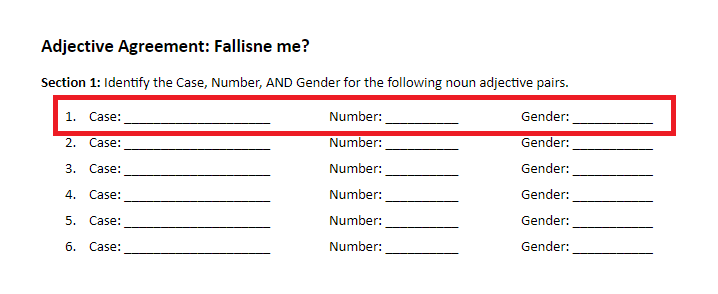
As I go through how to play this game, I will be using this Latin Adjective Review. It's designed for a Level 1 Latin class that is learning Adjective/Noun Agreement for 1st and 2nd Declension Nouns. I use this worksheet to go along with the game.

1. Divide the class into 2-3 teams (depending on the size).  Each team will be gaining or losing points together, but students are responsible for their own answers.

2. Each question will be presented one at a time. The entire class will get to see the question, but only one team at a time will get a chance to answer.

Present the first time with their first question.


Even though only the first team will get a chance to answer this questions for points, all students should write down their answer on their worksheets. Students are not allowed to use their notes or talk to each other - this part is an individual practice of the skills in this unit.

After giving students time to respond to the question, it's time to reveal the answer...

3. The next part is ONLY directed at the first team. Tell students that if they think they know the answer, they should stand up. Students aren't allowed to discuss with their group members a plan, they either stand up or they stay seated. If they stand up, though, they might be required to give their answer to the class. Write down the number of students who are standing on the board.
Tell the students who are standing that they should NOT call out an answer unless YOU ask them to.

4. This part is ONLY directed at the NEXT team. Ask these students to pick one of the students who is standing to answer. They can discuss with their group who they want to answer. When they've made their final decision, they tell you and then YOU ask that that student to reveal their answer.
If students who are standing call out an answer before YOU ask them to, that's an automatic wrong answer. Make sure you emphasize this to students beforehand.

5. The student reveals their answer, then you put the correct answer on the board for everyone to see.


If their answer is correct, their team gains points for each person who stood up. If their answer is incorrect, their team loses those points. So if seven students stood up, the team would gain seven points for a correct answer and lose seven points for an incorrect answer.

6. Move on to the next team. The process repeats with a new question for the next team. Cycle through all the teams until you're out of questions (though make sure each team gets the same number of questions). Keep track of the points on the board.

7. Strategy: It's called the Bluffing Game for a reason - students don't actually need to know the correct answer to help their team gain points. If they stand up confidently, they're less likely to get picked. If they hesitate and make a show of being uncertain, it might increase their chances of being called to answer. Let students know this as you go through more rounds. It adds an extra bit of fun for students :)

8. At the end of the game, I like to include a bonus round. This is usually a short translation. Students wager the points they have - if they get the sentence completely correct, they'll get that many points, but if there's even one error, they'll lose that many points. Students need to wager before they get to see the sentence.

Note: For teams that are in the negatives, tell them you'll boost them to +5 points if they get it right (or some other positive number, just so they're still in the game). 

Once wagers are in, show the class the sentence. At this point, students are allowed to work with their group and use their notes. They only need to submit one answer per team. 

9. Once all the teams have submitted their sentence, reveal how each team did and determine the winner.

Hopefully this is a game your students will enjoy playing - I know mine tend to get pretty competitive with it! Let me know if you have any questions or if you try it out and have recommendations for tweaks!

- Frau Leonard

Thursday, November 5, 2015

ThingLink and Padlet: Aeneas

These are two online resources that I've been meaning to try for a long time but only just implemented today with my Latin 1 class.  This specific lesson, although part of a lesson on the Trojan War and Aeneas, could be used with any character study or story summary.

I gave students several images related to the stories we'd talked about.  With their groups, they needed to create a ThingLink for two of them.  With ThingLink, they had to put in thought bubbles for what the characters were thinking about during that scene.  I used this one I had done as an example: 


ThingLink is free, but students did need to sign up for an account.

The next step was to post their images somewhere that was accessible to both me and other students.  For this, I created a Padlet page.  Padlet only requires me to have the account, so it was easy for students to post.  I helped walk students through how to post images (it's actually really simple, I promise!).  Once posted, anyone can view them.  Here's our class Padlet for this assignment:


I liked the ThingLink activity as an alternate way of assessment for this topic.  It's relatively easy once students know what they're doing (and now we can do it with later myths!) and it's nice to pull in technology whenever I can.  Students seemed to enjoy the activity itself.

Padlet also works really well for getting students to submit digital assignments - it's easier for me than managing a list of links or a million emails.  It also looks decent :) and lets students view each other's work.  The only issue is that the URL for your current Padlet board is usually pretty long and difficult to easily get to students.

- Frau Leonard

Tuesday, October 27, 2015

Comparative and Superlative

Just a quick post today about an activity to practice the comparative and superlative (I have some longer posts planned but no time as of yet to write them out!).  I have students bring in pictures or magazines as a homework assignment.  In class we discuss various current movies, books, tv shows, celebrities, etc. using the comparative.  I then have them create their own image pages to express their opinions.

The rules: they need 6 pictures, 3 examples of the comparative and 2 of the superlative.


It's a really simple activity - though finding pictures and cutting them up will take up some time - that's a practical use of a skill they're learning.  It's also pretty easy to check and give feedback on.  As an extension, I think I'll divy them up and have them write ways they disagree with the statements there.

This is leading us into our upcoming Class Superlatives Activity, which we'll be doing this Friday.  If you're interested in more Comparative and Superlative activites for German, check out my bundle on TPT by clicking here.

- Frau Leonard

Tuesday, October 6, 2015

Animal Cracker Review Box

This is a cute review activity I learned a few years ago from another World Language Teacher.  It's a great tool for review stations, especially before a large test that involves multiple choice questions.

Here's what you'll need:

  • Animal Cracker Box(es)
  • Golf Tee(s)
  • Flashcards
  • One-hole punch


Set-Up: 
1. Cut up an animal cracker box.  You might be thinking, "Why an animal cracker box?"  Well, it turns out they're the perfect size for flashcards to fit in!  You'll need to cut the front off as shown below.  

2. Create question cards.  You'll need one flashcard per question.  Questions go on the top of the card, answers right below.  Each question needs to be multiple choice and you'll need three possible answers.  Make sure everything on the card is visible when it's been placed inside the box.

3. Punch holes.  Punch 3 holes on the bottom of the box (as you may have noticed in the pictures above) and on the bottom of each card.  For the cards, you'll need one hole below each answer.  Make sure the holes on the cards line up with the holes in the box.

4. Mark correct answers.  Cut out the bottom of the holes below the correct answers on each card, as below.

5. Put it all together!  Put the finished cards int he box.  To practice, students put their golf tee in the hole under whatever they think the right answer is.  Once they've put the golf tee in, they try to (gently!) pull up that card.  If it comes up, they got it right!  If it doesn't, they got it wrong and need to try again.


This is a good review activity since it requires minimal effort from you when students are doing it.  Once they know the process, they can go through cards at their own speed and get instant feedback about how they're doing.  Students love using it, too!  The only downside is how time intensive it is to make the cards - I usually get my student aides to go through the process of actually getting the cards ready, and then I can put the questions and answers on.  

- Frau Leonard