Tuesday, April 16, 2019

Ostern in Deutschland

This year as I continue to adjust to my new role as a middle school language teacher, I've been taking a cue from my department members and use holidays and crafts to engage student interest. The latest installment: Ostern!

I started with a bulletin board at the beginning of the month. I included some Easter egg decorations ad well as some facts about German traditions. And of course, all the decorations are "hanging" in an Osterbaum :)


As we got closer to the holiday, I had activities for both my 8th and 7th grade classes. I only did one day worth of activities for the 7th graders on our last day before break. For 8th graders, we did two days.

Eight graders learned about Easter traditions in more detail (using the bulletin board, a Kahoot, and a Deutsche Welle article), and then decorated some Ostereier.


Students then hung up their eggs around the classroom. I did initially give them relatively free reign, but that just lead to lone eggs, which doesn't really convey the whole Osterbaum idea. I ended up moving them to two main locations and in the future I would give students one specific area. My original plan was to have a tree made out of construction paper hanging on the wall outside my room, but I'd recently hung up some student work and didn't have the room. Next year!

All classes did an Easter egg hunt on the last day before our break. I broke students into groups, each with a color assigned. I bought about $4 worth of plastic eggs from Target to use - I think I ended up with six different colors, eight eggs each. Groups took turns looking for their color eggs around the room, collecting them at their desks.


Each egg had a slip (or a couple slips) of paper inside. For 7th grade, they had spring related vocabulary words - they had to match the vocabulary with pictures; for 8th grade, they had sentence fragments that they had to put together. When a group had found all their eggs and used all their words correctly, they brought up their finished work to trade in for candy.

I color coded student papers so each group a.) knew who was in the group and b.) knew what their color was. I didn't want any issues with students not

When students were done, they helped fill the eggs for the next class. They also got to hide them for the next class, a task which they very much enjoyed! Their only guidelines: the eggs had to be in plain sight, somewhere people could see them without having to touch anything, just by walking around the room (i.e. not under things or inside cabinets). I had my last class of the day hide them for the first class a day ahead of time so no group was left out.

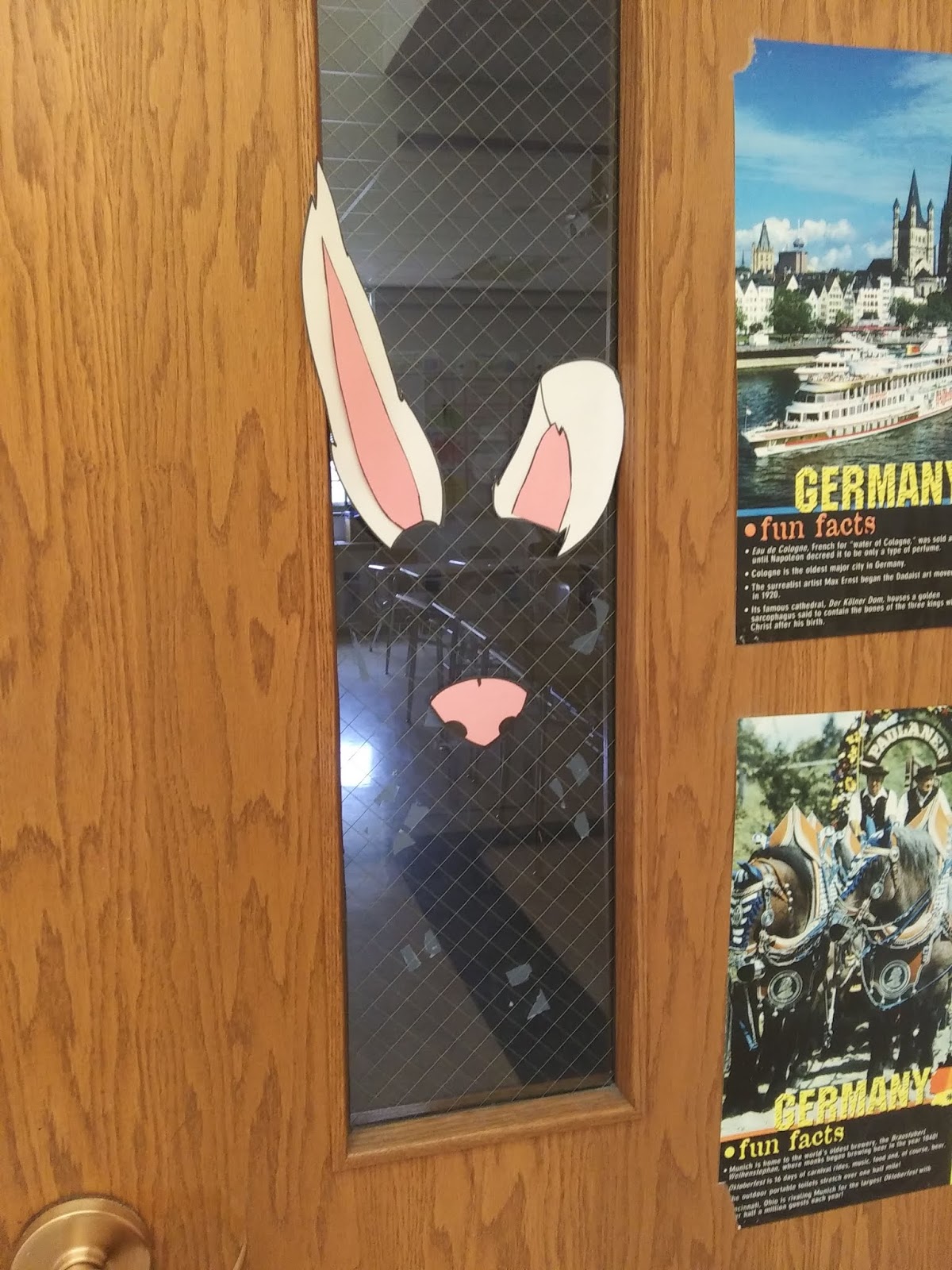
I also like to have a Selfie Station for holidays. I have a holiday-related decoration up on my door window. Students stand inside the room and look outside, then someone outside the room takes their picture - this time students would look like the Osterhase in their pictures.

Note: I will have my materials available via Teachers Pay Teachers within a few days! I know that will be too late for this year, so I wanted to post early enough that anyone with classes later this week could try to incorporate some of these activities. I should also have more pictures up soon! (I also tend to post more pictures on our class Instagram account!)

What holiday celebrations do you bring into the classroom? Do you do anything for Ostern?

- Frau Leonard


Friday, April 12, 2019

Ampel Check-In

This is actually an extension of an earlier post I did on the same topic - using this Ampel / Stop Light system to have students check in mid-unit to self-assess their understanding.

I started using a more general check-in, no specific tasks listed. Just a quick self-reflection on how they're doing with the material and a short sentence completion to identify specific things they have issues with or think are easy. It's general enough that I can reuse the same slide for multiple topics.


I used large flashcards and gave one to each student with their name already on it. On their card, they identified where they were with the topic (Modal Verbs in this case) and wrote their sentence. I had three colored envelops on the board, and they put their flashcard in whichever color applied to them.


I then went through the cards and answered the questions students had in the Red section, helped clear up things/give tips for students in the Yellow section, and did a quick read through of the Green section to make sure they seemed to be on the right track. I then gave the cards back to students the next day (shuffling them first so no one would be able to tell what color they'd initially used).


I also used a highlighter to mark where they'd put their card, just for future reference. The plan is to use this system for the rest of the year as a check-in, using the same cards until they get filled up. It opens up communication with students and lets me keep track of students mid-way through a unit. It's also a good point of conversation for students who initially said they did understand but don't perform well on assessments - did they really not understand? what are their study methods? do they have anxiety during quizzes?

So far so good, though admittedly I've only used it once so far :)

- Frau Leonard

Tuesday, April 2, 2019

Things Every Teacher Needs in Their Desk

This isn't about teaching strategies or anything like that - this is way more practical. It's the type of thing you usually learn after years of experience, but it's something everyone needs to consider whenever they get a new classroom: what do you need to keep in your desk?

Obviously there are school supplies like pens, pencils, post-its, and all that. That's a completely different thing from what I'm talking about right now. I mean things that you personally might need during the school year for surprise or emergency situations.

So in no particular order, here are things I try to keep in my desk:

  • Deodorant
  • Brush/Comb
  • Mirror
  • Change of Clothes (I have spilled coffee on myself twice this year...)
  • Cell Phone Charger
  • Box of Bandaids (I have also cut my hand open twice from paper clips this year...)
  • Non-perishable snack items (instant soup, chips, cliff bars, candy, etc)
  • Water Bottles
  • Gum/Breath mints
  • Blanket/Sweater
  • Advil (or equivalent)
  • Cough Drops
  • Chapstick
  • Hair Ties
  • Pads/Tampons
  • Thumb Drive (kind of work related, but sometimes you need a way to transfer files/print things/whatever)

Are there any items you keep on hand just in case?

- Frau Leonard

Monday, March 25, 2019

Maerchen und die Gebrueder Grimm

This year I'm working with seventh graders in a German Exploration class. The purpose of the class is to introduce students to German language and culture over 12 weeks, but in a way that's fun as much as it is informative. Throughout the year, I've tried to bring in culture through holidays and holiday-related crafts, but with my last group of seventh graders, I decided to bring in some history and literature as well!

We did a whole two week unit on fairy tales, looking at the Brothers Grimm and some of their more well known stories. Students learned about the brothers, the main fairy tale tropes, and then read some stories as a class to analyze. After they got a handle on what "traditional" fairy tales looked like without the Disney sugarcoating they're used to, students broke into groups to pick a German fairy tale to read, analyze, and then share with the class.

Students had fun and were generally scandalized/enraptured by the original versions of the stories. Some kids were already familiar with them, but for the most part there was something new for them in whatever story they happened to pick. I really had to emphasize with them to read the story I gave them though and not rely on their Disney knowledge (unfortunately some groups did not heed this advice...).

They also produced some great art! Check out these character charts they made for the good guys/bad guys in their stories:


I made a huge castle in the hallway outside our room - great way to show off student work and draw some attention ;)


In addition to the fairy tale charts, students made comics that summarized their fairy tales so they could share them with other groups.

If you'd like to purchase the full unit to use with your students, please check it out on TpT!

- Frau Leonard

Thursday, March 21, 2019

Go Guardian Scenes

I am at a school that is fortunate to be 1:1 with district issued Chromebooks. As part of this new technology driven initiative in the schools, we've adopted GoGuardian as a part of our classroom management system. The other day another teacher complimented me on my GoGuardian scenes, so I thought I'd just briefly go over the scenes I have set up! I've listed them here in the order I use them, from most frequent to least frequent.


General Classroom
I use this day to day as my default scene. It allows students to get to the websites they might need for class but blocks them from ones that they a.) shouldn't be using at all, ever and/or b.) ones that aren't necessary for most of what we do in class.
Keep in mind, if your kiddos are like mine, they are used to typing in the website they want - for Quizlet, they're used to typing in "quizlet" in the URL tab. You will have to explain to students what a URL is and what the URL is for a lot of these common websites.
Settings: Block Mode
Enabled Websites: Kahoot, Kami, Google Docs, Google Drive, Google Classroom, Gmail, Quizlet, Duolingo, Flipgrid, Vocaroo, Make Beliefs Comix, Leo.org, Beolingus, Conjuguemos, Nearpod, Skyward (our grading platform), Wikipedia (English and German), Google Calendar, Poll Everywhere, Padlet, Quia

Doing Research
Used when (surprise surprise!) students are doing some sort of research that requires them to have much fewer restrictions than usual.
Settings: Allow Mode
Blocked Sites: Google Translate, Cookie Counter (we had a huge issue with Cookie Counter at the beginning of the school year...)

Post Quiz
After quizzes, if students finish early I let them go on their computers to play Duolingo. This gives them something related to the target language to work on, doesn't put them in a position to get too far ahead on material, and keeps them from getting bored. It also hopefully builds that routine of using Duolingo, which I hope they'll continue to do over the summer just as a way to keep some language input.
Settings: Block Mode
Enabled Websites: Duolingo
Auto Open Tab: Duolingo

Taking Notes
Used for taking notes and I want to eliminate distractions such as Quizlet. Especially with vocabulary lists, if I post the Quizlet set with the notes (as I usually do), I find students are often distracted by the list and want to copy things from Quizlet instead of listening to me and doing the pronunciation practice we typically do together.
Settings: Block Mode
Enabled Websites: Google Docs, Google Drive, Google Classroom

Open Note Quiz
Not something I do often, but in the event I want students to do an open note quiz, this is the scene I use.
Settings: Block Mode
Enabled Sites: Google Docs, Google Drive, Quizlet, Duolingo, Google Classroom

Quizzes
If I'm doing a Quiz online through Google Forms, this is the scene I use. I played around with this type of quiz at the beginning of the school year and found that at least right now, this isn't for me and have switched back to paper quizzes. I have one for 7th Grade and one for 8th Grade, just in case they're testing on the same day.
If I were doing a Flipgrid test, I would just switch out everywhere that says Google Forms with Flipgrid.
Settings: Block Mode
Enabled Websites: Google Docs, Google Forms, Duolingo
Auto-Open Tabs: Google Forms (the specific URL for the actual Quiz)
Max Tabs: 1

Do you use GoGuardian in class? What websites would you need your students to have access to (I know for me I'm constantly adding more as we get to an assignment that requires something new - PollEverywhere only got added a few weeks ago so we could do March Madness and Padlet similarly so we could do a brainstorming activity for the German school system)? Do you use Duolingo at all with your students, and if so, how?

- Frau Leonard

Thursday, March 14, 2019

Hast du Schwein?

So let me start by saying I have a collection of stuffed pigs. The start of this collection are a little murky (I know I got one when student teaching for a game I made called Pig Latin, but where the subsequent pigs came from I have no idea!), but for years now these piggies have been decorating my classrooms. There's always a moment when my new students will look around suspiciously and ask if I like pigs (or worryingly comment that they're "surrounded").

Recently, I decided to put my pig collection to use.


I added a sign so that my students could ask to have a pig with them during class and refer to them as "emotional support pigs."


I was worried there'd be issues with students playing around with the pigs, but there hasn't actually been that much of that. It takes one warning that they permanently lose pig privileges and they stop goofing off. Mostly students keep them on their laps or desk while they work. For a few of my more squarely kiddos, it's actually seemed to help them focus.

- Frau Leonard


Monday, March 11, 2019

First Day Activities

The middle school where I work has three 12 week sessions of 7th grade classes that cycle through the three languages we offer here (French, German, Spanish). Today I just got my last batch of 7th graders for the year, and last week I came up with a new activity that I think is a good one for Day One with students who are unfamiliar with you, the language, and/or your room.

I frequently have had problems with students just not being aware of the resources around them - words that are on posters, where to find markers/scissors/etc, and where the homework is listed. Even after weeks together, some students still weren't aware of everything they had available to them, so I came up with a "Room Investigation" activity.

I looked at my room - the posters, the bulletin boards, the layout, etc - and came up with questions for three categories: German vocab, German culture, and class procedures. Using just the materials visible in the room, they had to answer questions such as "How do you say blue in German?" (I have color posters on one part of the wall) or "What is Oktoberfest?" (there are several Oktoberfest posters) or "Where are the German dictionaries?" (there are a bunch on a bookshelf).


You can see the full worksheet here (and if you'd like a copy, click on "File" and scroll down to "Make a Copy").

This gets students moving around the room (breaking up an otherwise procedure/policy heavy first day) and gets them some fun and also practical words while getting them a better idea of what's around them. Hopefully this will help clear up confusion as well!

- Frau Leonard